| For integrals involving | Use the substitution | Use the identity |
|---|---|---|
| \(\sqrt{a^2-x^2}, \; a>0 \) | \(x = a \sin \theta, \; \frac{-\pi}{2} \leq \theta \leq \frac{\pi}{2} \) | \( 1- \sin^2 \theta = \cos^2 \theta \) |
| \(\sqrt{a^2+x^2}, \; a>0 \) | \(x = a \tan \theta, \; \frac{-\pi}{2} < \theta < \frac{\pi}{2} \) | \( 1+\tan^2 \theta = \sec^2 \theta \) |
| \(\sqrt{x^2-a^2}, \; a>0 \) | \(x = a \sec \theta, \; 0 \leq \theta < \frac{\pi}{2} \text{ or } \frac{\pi}{2} < \theta \leq \pi \) | \( \sec^2 \theta – 1 = \tan^2 \theta \) |
Trigonometric Substitution
| For integrals involving | Use the substitution | Use the identity |
|---|---|---|
| \(\sqrt{a^2-x^2}, \; a>0 \) | \(x = a \sin \theta, \; \frac{-\pi}{2} \leq \theta \leq \frac{\pi}{2} \) | \( 1- \sin^2 \theta = \cos^2 \theta \) |
| \(\sqrt{a^2+x^2}, \; a>0 \) | \(x = a \tan \theta, \; \frac{-\pi}{2} < \theta < \frac{\pi}{2} \) | \( 1+\tan^2 \theta = \sec^2 \theta \) |
| \(\sqrt{x^2-a^2}, \; a>0 \) | \(x = a \sec \theta, \; 0 \leq \theta < \frac{\pi}{2} \text{ or } \frac{\pi}{2} < \theta \leq \pi \) | \( \sec^2 \theta – 1 = \tan^2 \theta \) |
Trigonometric Substitution
- For integrals involving \(\sqrt{a^2-x^2}, \; a>0 \)
- use the subsitution
$$x = a \sin \theta, $$
where \(\frac{-\pi}{2} \leq \theta \leq \frac{\pi}{2}\) - and the identity
$$ 1- \sin^2 \theta = \cos^2 \theta $$ - For integrals involving \(\sqrt{a^2+x^2}, \; a>0 \)
- use the substitution
$$x = a \tan \theta,$$
where \(\frac{-\pi}{2} < \theta < \frac{\pi}{2}\) - and the identity
$$ 1+\tan^2 \theta = \sec^2 \theta $$ - For integrals involving \(\sqrt{x^2-a^2}, \; a>0 \)
- use the substitution
$$x = a \sec \theta,$$
where \(0 \leq \theta < \frac{\pi}{2}\) or \(\frac{\pi}{2} < \theta \leq \pi \) - and the identity
$$ \sec^2 \theta – 1 = \tan^2 \theta $$
Find
$$
\int \frac{1}{(4+x^2)^2} \; dx
$$
$$
\int \frac{1}{(4+x^2)^2} \; dx
$$
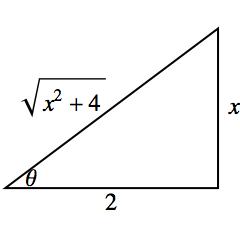
Let \(x = 2\tan \theta \) then \( dx = 2\sec^2 \theta \; d \theta \) and
$$
\begin{aligned}
\int \frac{1}{(4+x^2)^2} \; dx & = \int \frac{1}{((4+ (2 \tan \theta )^2)^2} 2\sec^2 \theta \; d \theta \\
& = \int \frac{1}{16(1+\tan^2 \theta)^2} 2\sec^2 \theta \; d \theta \\
& = \int \frac{1}{16 \sec^4 \theta} 2\sec^2 \theta \; d \theta \\
& = \int \frac{1}{8 \sec^2 \theta} \; d \theta = \frac{1}{8}\int \cos^2 \theta \; d \theta \\
& = \frac{1}{8}\int \frac{1+ \cos(2 \theta)}{2} \; d \theta \\
& = \frac{1}{16}\int 1+ \cos(2 \theta) \; d \theta \\
& = \frac{1}{16}\left( \theta+ \frac{\sin(2 \theta)}{2} \right) + C \\
& = \frac{1}{16}\left( \theta+ \frac{2\sin(\theta) \cos(\theta) }{2} \right) + C \\
\end{aligned}
$$
\begin{aligned}
\int \frac{1}{(4+x^2)^2} \; dx & = \int \frac{1}{((4+ (2 \tan \theta )^2)^2} 2\sec^2 \theta \; d \theta \\
& = \int \frac{1}{16(1+\tan^2 \theta)^2} 2\sec^2 \theta \; d \theta \\
& = \int \frac{1}{16 \sec^4 \theta} 2\sec^2 \theta \; d \theta \\
& = \int \frac{1}{8 \sec^2 \theta} \; d \theta = \frac{1}{8}\int \cos^2 \theta \; d \theta \\
& = \frac{1}{8}\int \frac{1+ \cos(2 \theta)}{2} \; d \theta \\
& = \frac{1}{16}\int 1+ \cos(2 \theta) \; d \theta \\
& = \frac{1}{16}\left( \theta+ \frac{\sin(2 \theta)}{2} \right) + C \\
& = \frac{1}{16}\left( \theta+ \frac{2\sin(\theta) \cos(\theta) }{2} \right) + C \\
\end{aligned}
$$
$$
\begin{aligned}
\int \frac{1}{(4+x^2)^2} \; dx & = \int \frac{1}{((4+ (2 \tan \theta )^2)^2} 2\sec^2 \theta \; d \theta \\
& = \int \frac{1}{16(1+\tan^2 \theta)^2} 2\sec^2 \theta \; d \theta \\
& = \int \frac{1}{16 \sec^4 \theta} 2\sec^2 \theta \; d \theta \\
& = \int \frac{1}{8 \sec^2 \theta} \; d \theta = \frac{1}{8}\int \cos^2 \theta \; d \theta \\
& = \frac{1}{8}\int \frac{1+ \cos(2 \theta)}{2} \; d \theta \\
& = \frac{1}{16}\int 1+ \cos(2 \theta) \; d \theta \\
& = \frac{1}{16}\left( \theta+ \frac{\sin(2 \theta)}{2} \right) + C \\
& = \frac{1}{16}\left( \theta+ \frac{2\sin(\theta) \cos(\theta) }{2} \right) + C \\
\end{aligned}
$$
\begin{aligned}
\int \frac{1}{(4+x^2)^2} \; dx & = \int \frac{1}{((4+ (2 \tan \theta )^2)^2} 2\sec^2 \theta \; d \theta \\
& = \int \frac{1}{16(1+\tan^2 \theta)^2} 2\sec^2 \theta \; d \theta \\
& = \int \frac{1}{16 \sec^4 \theta} 2\sec^2 \theta \; d \theta \\
& = \int \frac{1}{8 \sec^2 \theta} \; d \theta = \frac{1}{8}\int \cos^2 \theta \; d \theta \\
& = \frac{1}{8}\int \frac{1+ \cos(2 \theta)}{2} \; d \theta \\
& = \frac{1}{16}\int 1+ \cos(2 \theta) \; d \theta \\
& = \frac{1}{16}\left( \theta+ \frac{\sin(2 \theta)}{2} \right) + C \\
& = \frac{1}{16}\left( \theta+ \frac{2\sin(\theta) \cos(\theta) }{2} \right) + C \\
\end{aligned}
$$
$$
\begin{aligned}
\int & \frac{1}{(4+x^2)^2} \; dx \\
& = \int \frac{1}{((4+ (2 \tan \theta )^2)^2} 2\sec^2 \theta \; d \theta \\
& = \int \frac{1}{16(1+\tan^2 \theta)^2} 2\sec^2 \theta \; d \theta \\
& = \int \frac{1}{16 \sec^4 \theta} 2\sec^2 \theta \; d \theta \\
& = \int \frac{1}{8 \sec^2 \theta} \; d \theta = \frac{1}{8}\int \cos^2 \theta \; d \theta \\
& = \frac{1}{8}\int \frac{1+ \cos(2 \theta)}{2} \; d \theta \\
& = \frac{1}{16}\int 1+ \cos(2 \theta) \; d \theta \\
& = \frac{1}{16}\left( \theta+ \frac{\sin(2 \theta)}{2} \right) + C \\
& = \frac{1}{16}\left( \theta+ \frac{2\sin(\theta) \cos(\theta) }{2} \right) + C \\
\end{aligned}
$$
\begin{aligned}
\int & \frac{1}{(4+x^2)^2} \; dx \\
& = \int \frac{1}{((4+ (2 \tan \theta )^2)^2} 2\sec^2 \theta \; d \theta \\
& = \int \frac{1}{16(1+\tan^2 \theta)^2} 2\sec^2 \theta \; d \theta \\
& = \int \frac{1}{16 \sec^4 \theta} 2\sec^2 \theta \; d \theta \\
& = \int \frac{1}{8 \sec^2 \theta} \; d \theta = \frac{1}{8}\int \cos^2 \theta \; d \theta \\
& = \frac{1}{8}\int \frac{1+ \cos(2 \theta)}{2} \; d \theta \\
& = \frac{1}{16}\int 1+ \cos(2 \theta) \; d \theta \\
& = \frac{1}{16}\left( \theta+ \frac{\sin(2 \theta)}{2} \right) + C \\
& = \frac{1}{16}\left( \theta+ \frac{2\sin(\theta) \cos(\theta) }{2} \right) + C \\
\end{aligned}
$$
Since \(x = 2 \tan \theta\), \( \tan \theta = \frac{x}{2} \) and \( \theta = \tan^{-1}\left( \frac{x}{2} \right) \). Also
$$
\sin \theta = \frac{x}{\sqrt{4+x^2}} \text{ and } \cos \theta = \frac{2}{\sqrt{4+x^2}}.
$$
So,
$$
\begin{aligned}
\int \frac{1}{(4+x^2)^2} \; dx & = \frac{1}{16}\left( \tan^{-1}\left( \frac{x}{2} \right)+ \frac{2\frac{x}{\sqrt{4+x^2}} \frac{2}{\sqrt{4+x^2}}}{2} \right) + C \\
& = \frac{1}{16} \left(\tan^{-1}\left( \frac{x}{2} \right)+ \frac{2x}{\sqrt{4+x^2}} \right) + C
\end{aligned}
$$
\begin{aligned}
\int \frac{1}{(4+x^2)^2} \; dx & = \frac{1}{16}\left( \tan^{-1}\left( \frac{x}{2} \right)+ \frac{2\frac{x}{\sqrt{4+x^2}} \frac{2}{\sqrt{4+x^2}}}{2} \right) + C \\
& = \frac{1}{16} \left(\tan^{-1}\left( \frac{x}{2} \right)+ \frac{2x}{\sqrt{4+x^2}} \right) + C
\end{aligned}
$$
$$
\begin{aligned}
\int & \frac{1}{(4+x^2)^2} \; dx \\
& = \frac{1}{16}\left( \tan^{-1}\left( \frac{x}{2} \right)+ \frac{2\frac{x}{\sqrt{4+x^2}} \frac{2}{\sqrt{4+x^2}}}{2} \right) + C \\
& = \frac{1}{16} \left(\tan^{-1}\left( \frac{x}{2} \right)+ \frac{2x}{\sqrt{4+x^2}} \right) + C
\end{aligned}
$$
\begin{aligned}
\int & \frac{1}{(4+x^2)^2} \; dx \\
& = \frac{1}{16}\left( \tan^{-1}\left( \frac{x}{2} \right)+ \frac{2\frac{x}{\sqrt{4+x^2}} \frac{2}{\sqrt{4+x^2}}}{2} \right) + C \\
& = \frac{1}{16} \left(\tan^{-1}\left( \frac{x}{2} \right)+ \frac{2x}{\sqrt{4+x^2}} \right) + C
\end{aligned}
$$
$$
\begin{aligned}
& \int \frac{1}{(4+x^2)^2} \; dx \\
& = \frac{1}{16}\left( \tan^{-1}\left( \frac{x}{2} \right)+ \frac{2\frac{x}{\sqrt{4+x^2}} \frac{2}{\sqrt{4+x^2}}}{2} \right) + C \\
& = \frac{1}{16} \left(\tan^{-1}\left( \frac{x}{2} \right)+ \frac{2x}{\sqrt{4+x^2}} \right) + C
\end{aligned}
$$
\begin{aligned}
& \int \frac{1}{(4+x^2)^2} \; dx \\
& = \frac{1}{16}\left( \tan^{-1}\left( \frac{x}{2} \right)+ \frac{2\frac{x}{\sqrt{4+x^2}} \frac{2}{\sqrt{4+x^2}}}{2} \right) + C \\
& = \frac{1}{16} \left(\tan^{-1}\left( \frac{x}{2} \right)+ \frac{2x}{\sqrt{4+x^2}} \right) + C
\end{aligned}
$$