Let \(f\) be a continuous nonnegative function on \([a,b],\) and let \(R\) be the region under the graph of \(f\) on the interval \([a,b].\) The volume of the solid of revolution generated by revolving \(R\) about the \(x\)-axis is
$$
V = \lim_{n \rightarrow \infty} \sum_{k =1}^n \pi [f(c_k)]^2 \; \Delta x = \int_a^b \pi[f(x)]^2 \; dx
$$
$$
\int_a^b \pi [f(x)]^2-\pi[g(x)]^2 \; dx
$$
where \(f(x) \geq g(x) >0\) on \([a,b]\). \(f(x)\) represents the outer radius and \(g(x)\) represents the inner radius on \([a,b]\). When \(g(x)=0\) this formula is referred to as the disk method , otherwise this is referred to as the washer method.
Set up the integral(s) that represent the volume of the solid of revolution generated by revolving the enclosed region on the left about the \(x\)-axis.
$$
\begin{aligned}
\int_0^1 \pi(2)^2 \; dx + \int_1^2 \pi(x+1)^2-\pi \left( \sqrt{1-(x-2)^2} \right)^2\; dx \\
+ \int_2^3 \pi (3)^2-\pi \left( \sqrt{1-(x-2)^2} \right)^2 \; dx
\end{aligned}
$$
where
- on the interval \([0,1]\), the outer radius is given by \(f(x) = 2\) and the inner radius is given by \(g(x) = 0\)
- on the interval \([1,2]\), the outer radius is given by \(f(x) = x+1\) and the inner radius is given by \(g(x) = \sqrt{1-(x-2)^2}\).
- on the interval \([2,3]\), the outer radius is given by \(f(x) = 3\) and the inner radius is given by \(g(x) = \sqrt{1-(x-2)^2}\).
A ball of radius 17 has a round hole of radius 5 drilled through its center. Find the volume of the resulting solid.
Notice that this is equivalent to the standard solids of revolution problem:
Find the volume of the solid of revolution obtained by revolving the region bounded by the graphs of
$$
x = \sqrt{17^2-y^2}, \text{ and } x = 5
$$
about the \(y\)-axis.
The volume of the solid of revolution, by the washer method, is
$$
\begin{aligned}
V & = \int_{-\sqrt{264}}^{\sqrt{264}} \pi\left(\sqrt{289-y^2}\right)^2-25 \pi \; dy \\
& =\int_{-\sqrt{264}}^{\sqrt{264}}\pi (264-y^2) \; dy \\
& = \pi \left(264y-\frac{y^3}{3}\right)\Big|_{-\sqrt{264}}^{\sqrt{264}} \\
& =704 \sqrt{66} \pi \approx 17967.8
\end{aligned}
$$
$$
V = \lim_{n \rightarrow \infty} \sum_{k=1}^n A(c_k) \Delta x = \int_a^b A(x) \; dx
$$
Imagine the base of the solid centered on the \(xy\)-plane. Then the equation of the circle along the base is given by \(x^2+y^2 = 4\). Furthermore, the length of the base of the cross sectional region can now be seen to be \(4y\). Therefore, the area of the cross sectional region (square) is \(16y^2\). Since this cross sectional region is being moved along the \(x\)-axis, we know that the integral representing the volume of the solid must be expressed entirely in the variable \(x\) and since \(y = \pm\sqrt{4-x^2}\), we have
$$
V = \int_{-2}^2 16(4-x^2) \; dx = \frac{512}{3}
$$
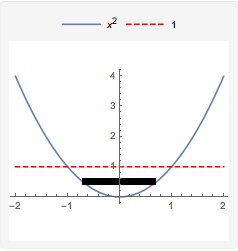
The cross-sections of the solid, taken perpendicular to the \(y\)-axis, are square. In which case, the volume that these cross-sections contribute to the overall volume of the solid is given by
$$
\begin{aligned}
\Delta V & = l^2 \cdot h \\
& = (\sqrt{y} – (-\sqrt{y}))^2 \cdot \Delta y \\
& = (2 \sqrt{y})^2 \; \Delta y \\
& = 4 |y| \; \Delta y \\
& = 4 y \; \Delta y
\end{aligned}
$$
for \(0 \leq y \leq 1\).
So the volume of the solid is given by
$$
V = \int_0^1 4y \; dy = 2y^2 \Big|_0^1 = 2
$$