The graphs of \(y = a \sin(bx-c) +d\) and \(y = a \cos(bx-c)+d\) have the following characteristics. (Assume \(b>0.\))
- The amplitude is given by \(|a|\) and represents half the distance between the maximum and minimum values of the function.
- The period is given by \(\displaystyle \frac{2\pi}{b}.\)
- The phase shift is given by \(c/b\).
- The center amplitude is given by \(d.\) The corresponding midline is given by \(y = d.\)
- The left and right endpoints of a one-cycle interval can be determined by solving the equations \(bx-c = 0\) and \(bx -c = 2\pi.\)
Sketch the graph of
$$
y = 4 \sin\left(x – \frac{\pi}{4} \right) +4.
$$
(Include two full periods.) Label \(x\) and \(y\) intercepts (if any). Find the amplitude, period, phase shift, and midline.
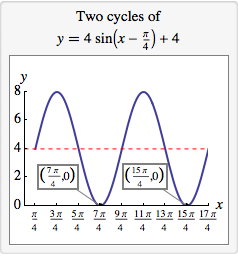
From the form of the equation we can have that \(a = 4,\) \(b = 1,\) \(c = \frac{\pi}{4},\) and \(d = 4.\) So that:
- The left and right endpoints of a two cycle interval can be determined by solving the equations \(x – \frac{\pi}{4} = 0\) and \(x – \frac{\pi}{4} = 4 \pi\). Thus, our two cycle interval is \([\pi/4, 17\pi/4]\).
- The amplitude is \(4.\)
- The period is \(\frac{2\pi}{b} = \frac{2\pi}{1} = 2\pi.\)
- The phase shift is \(\pi/4.\)
- The midline is \(y = 4.\)
- The \(y\)-intercept:
The two cycles we are sketched over the interval \([\pi/4,17\pi/4]\) which does not include \(x=0\). So our graph will not include a \(y\)-intercept. - The \(x\)-intercepts:
Set \(y = 0\). Then
$$
\begin{aligned}
& y = 4 \sin\left(x – \frac{\pi}{4} \right) +4 \\
\Rightarrow & 0 = 4 \sin\left(x – \frac{\pi}{4} \right) +4 \\
\Rightarrow & -1 = \sin\left(x – \frac{\pi}{4} \right) \\
\Rightarrow & x- \frac{\pi}{4} = \frac{3\pi}{2} + n 2\pi\\
\Rightarrow & x = \frac{3\pi}{2}+ \frac{\pi}{4} + n 2\pi\\
\Rightarrow & x = \frac{7\pi}{4} + n 2\pi\\
\end{aligned}
$$
So the \(x\)-intercepts over the interval \([\pi/4,17\pi/4]\) are \(\left(\frac{7\pi}{4},0\right)\) and \(\left(\frac{15\pi}{4},0\right)\).
Sketch the graph of
$$
y = -1 + 2 \cos \frac{\pi t}{12}.
$$
(Include two full periods.) Label \(t\) and \(y\) intercepts. Find the amplitude, period, phase shift, and midline.
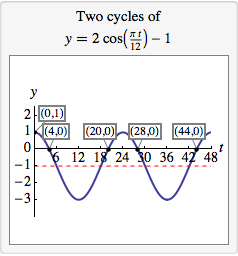
First rewrite the equation in standard form
$$
y = 2 \cos \left(\frac{\pi}{12} t \right) -1
$$
So that \(a = 2,\) \(b = \frac{\pi}{12},\) \(c = 0,\) and \(d = -1.\) Now we have the following:
- The left and right endpoints of a two cycle interval can be determined by solving the equations \(\frac{\pi}{12} t = 0\) and \(\frac{\pi}{12} t = 4 \pi\). Thus, our two cycle interval is \([0, 48]\).
- The amplitude is \(2.\)
- The period is \(\frac{2\pi}{b} = \frac{2\pi}{\frac{\pi}{12}} = 24.\)
- The phase shift is \(0.\)
- The midline is \(y = -1.\)
- The \(y\)-intercept:
Set \(t = 0\). Then
$$
\begin{aligned}
y & = -1 + 2 \cos \frac{\pi t}{12} \\
& = -1 + 2 \cos \frac{\pi 0}{12} \\
& = -1 + 2 \cos 0 \\
& = -1 + 2 = -1\\
\end{aligned}
$$
So the \(y\)-intercept is \(\left( 0,-2 \right)\) - The \(t\)-intercepts:
Set \(y = 0\). Then
$$
\begin{aligned}
& y = -1 + 2 \cos \frac{\pi t}{12} \\
\Rightarrow & 0 = -1 + 2 \cos \frac{\pi t}{12} \\
\Rightarrow & \frac{1}{2} = \cos \frac{\pi t}{12} \\
\Rightarrow & \frac{\pi t}{12} = \pm\frac{\pi}{3} +n 2\pi \\
\Rightarrow & t = \pm 4 +24 n \\
\end{aligned}
$$
So the \(t\)-intercepts over the interval \([0,48]\) are
$$
(4,0),(20,0),(28,0),(44,0).
$$